Work
Selected case studies in product strategy, technical leadership, and cross-functional execution.
PDP Accordion A/B Test
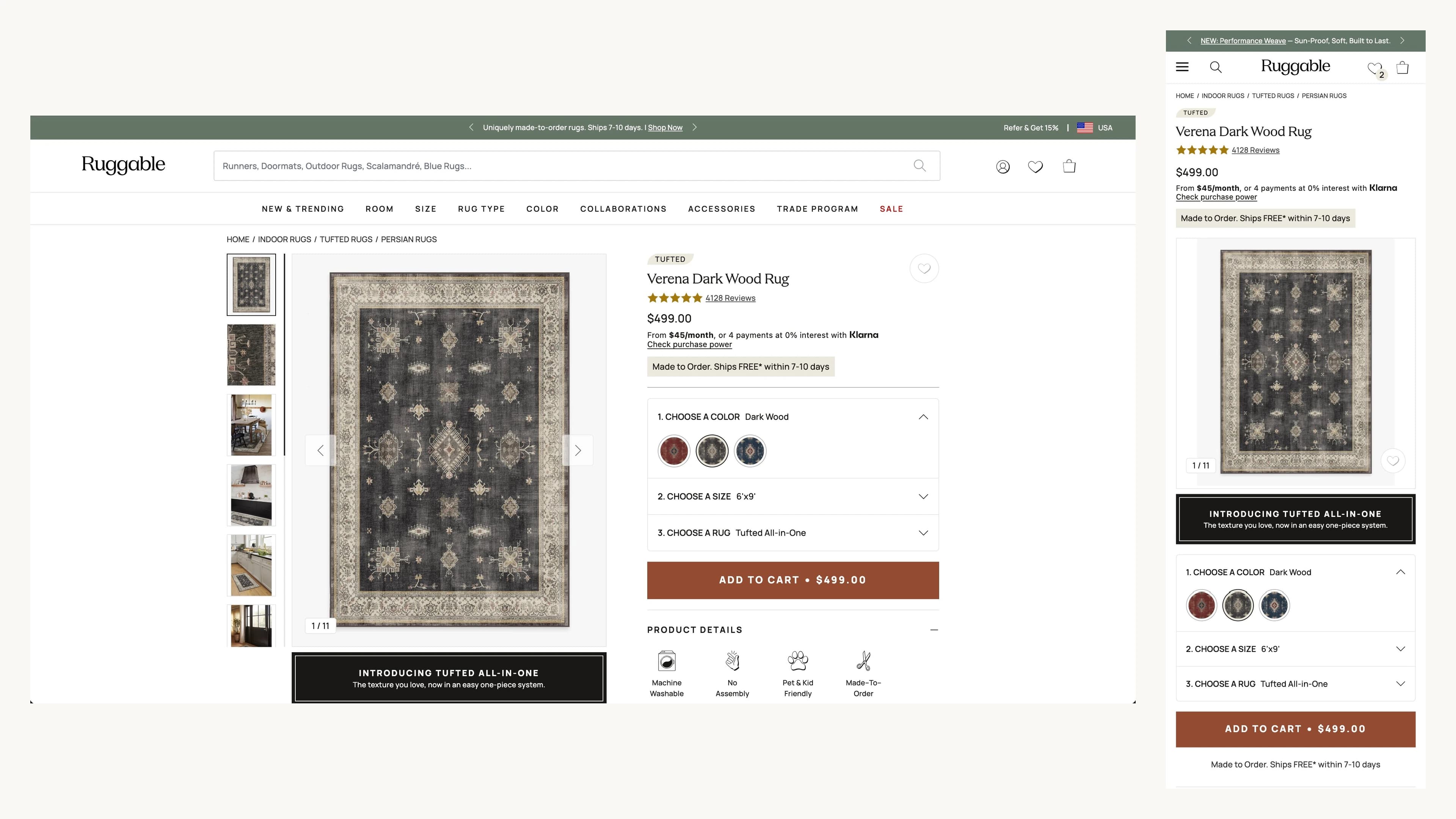
Using Behavioral Design Principles, I identified a UX/UI barrier on Ruggable's PDP that I hypothesized was impacting the core funnel. We user tested & A/B tested a PDP design variation, which ultimately improved ATC rate, CVR, and RPV.
Ruggable's PDP was overwhelming—featuring 20+ variant options in a single viewport to choose from, leading to cognitive overload/analysis paralysis, impacting the core funnel.
Designed a guided 'Accordion UI' with UX/UI that compressed 20+ variant choices into 3 categorical choices, reducing cognitive load and leaning on defaults to preserve the path of least resistance for high-intent users.
Validated the design with unmoderated user testing before commit; revised the prototype on R2 based on consistent friction points.
Architected an A/B test targeting users who interacted with the Rug PDP at 60% traffic exposure. Primary metric: ATC Rate; Guardrail metrics: CVR, RPV & AOV. Two-week run for traffic blend and significance.
Cut results across cohorts (new vs. returning, device, channel) with data science. Stat-sig positive across the board, outsized lift on new users—exactly what the choice-overload hypothesis predicted.
17% ATC, 6% CVR, 5% RPV, millions in incremental ARR. The choice-architecture hypothesis was right, and the cohort breakdown gave us a roadmap for the next round of tests.
The paradox of choice is real. Not all friction is bad for conversion. And a small UI change—expandable categories instead of exposed buttons—can move the funnel more than a full-fledged redesign.